

Kansas City planners have put the “trans” into transportation. Area makeover artists have been busily mutilating this once impressively livable city and transitioning it to something God never intended. This radical urban surgery has deformed many an American city, but none quite so thoughtlessly.
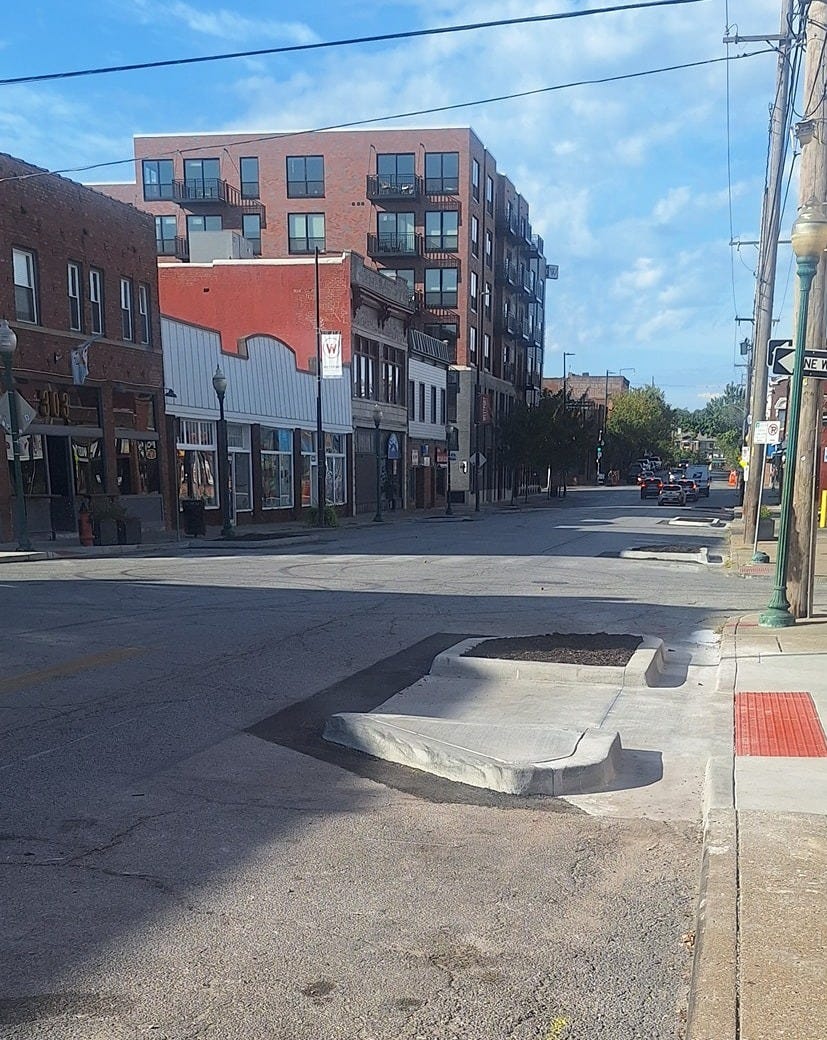
Let me explain. I returned to Kansas City last week after a month away and found the street in front of my office lined with concrete protrusions. Whatever their stated purpose, their effect is to cut parking spaces on this already parking-stressed street of small shops and restaurants by more than half. As to the unstated purpose, it can be nothing other than to get people out of their cars in time for the the grand opening of the KC Streetcar Main Street Extension on October 24, a streetcar extension that no city in the world needs less than Kansas City.
When I moved to Kansas City from metro New York many moons ago I was stunned by how auto-friendly the city was. On day two of living here, I drove to Royals stadium in 15 minutes. A trip to Yankee stadium, by contrast, could take hours. I could drive five miles to downtown KC from my midtown neighborhood on no fewer than six street-level thoroughfares, again in no more than 15 minutes on any one of them, even in rush hour.
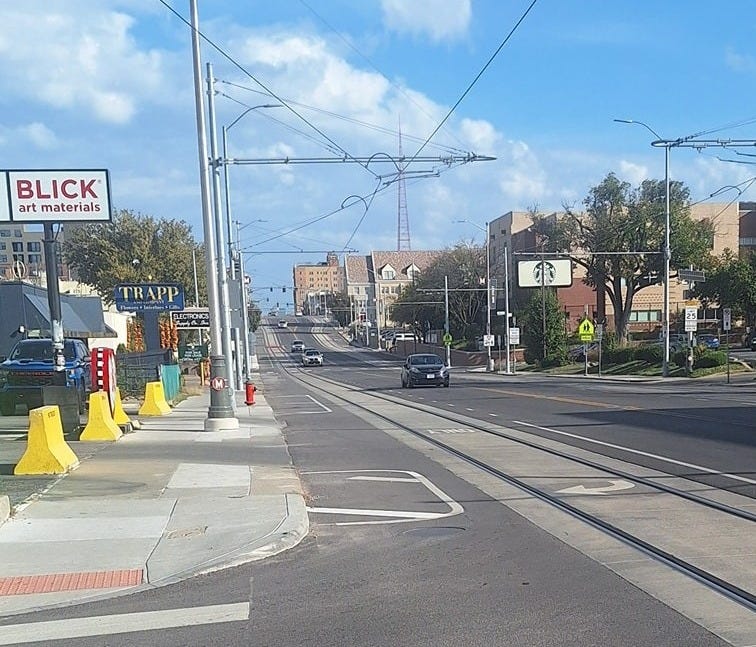
Rush Hour, Monday Morning, Main Street, Kansas City, days before the street car
Neighborhoods here were/are connected by an internationally celebrated network of boulevards, and if that were not enough to ease stress, Metro KC was blessed with more freeway miles per capita than any city in the world. Without trying, Kansas City had evolved into an organic 15-minute city. But what seemed like assets to a sane adult seemed liked liabilities to the skinny jeans crowd controlling our destiny. They wanted us out of our cars.
“October 24th will be a day to remember and celebrate as Kansas Citians ride into the future of public transportation, connecting neighborhoods in the urban core like never before,” said Kansas City Mayor Quinton Lucas. Well, not exactly “like never before.” Consider this observation from a local history site. “KC’s growing car industry made car ownership easier for suburbans, and bus lines were more convenient for reaching the outskirts of the city. Because of this, the last 20th century trolley route closed in 1957.”
At its peak, the system had 25 routes and more than 700 streetcars. By 1957, it had simply outlived its usefulness. The track lines were paved over or turned into neighborhood walking trails. All was copacetic until the ideologues replaced the civil engineers. Insecure about the city’s place on the national scene, many otherwise good citizens just followed along.
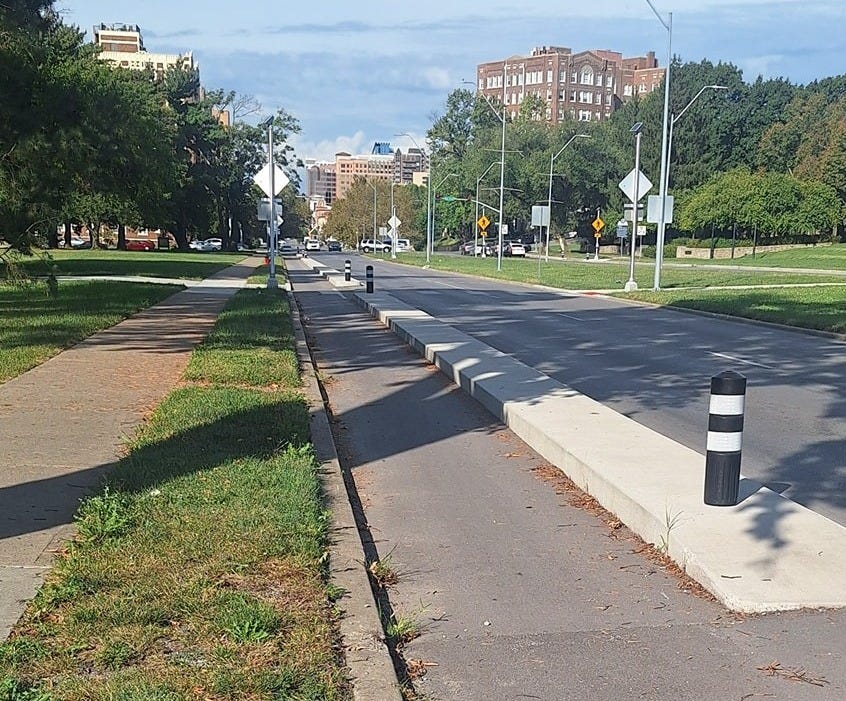
No sign of a cyclist on a 74-degree October day. In December, what?
I watched it happen. For the first 20 years of this century I moderated a monthly roundtable of local business leaders for a regional business magazine. No fewer than 50 of those sessions touched on urban planning in one context or another. From the beginning, urban planners saw KC’s blessings as an obstacle to overcome. Indeed, the Manson girls showed a greater range of thought than did the soft core Marxists leading the way.
As moderator, I could not argue with our guests, but I could and did prod. “What problem do we hope to solve?” I would ask. In the beginning, the participants often fell back on the need to recruit the “creative class.” This was the brainchild of best selling author Richard Florida who argued that a compressed urban environment with bike lanes, pedestrian walkways, and the like was necessary to attract a critical mass of “high bohemians.” The creativity of these artists, musicians, and gays was said to spur economic development, much as it was alleged to have done in Portland, the planners—no joke—urban beau ideal.
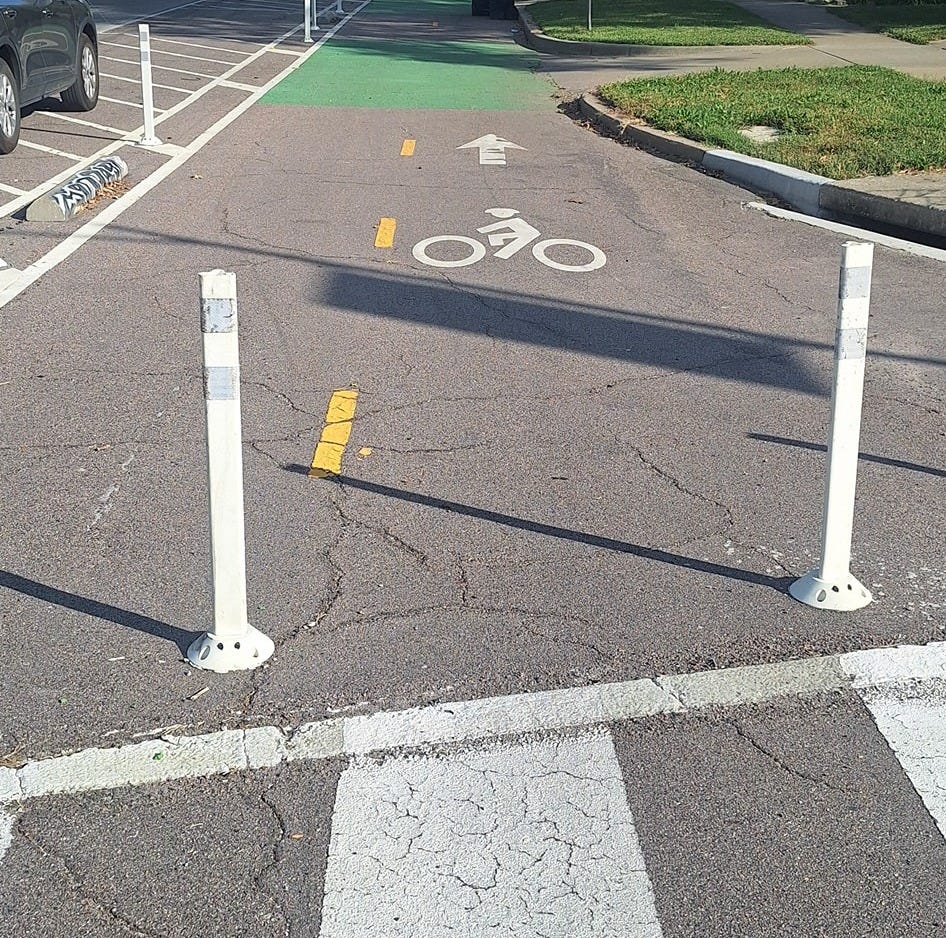
Carving up the city’s boulevards like cargo cultists waiting for cyclists to fall from the sky
Within a decade, Florida had come to doubt his own theory, but by this time “climate change” had become so accepted a bogey man in planning circles that no other rationale was needed. By this time, too, the movement to justify forcing people out of their cars and on to public transportation had a workable brand, “the 15-minute city.”
Tiffany Hsu of the New York Times traced the idea to France. As she explains, “The idea is that everyday destinations such as schools, stores and offices should be only a short walk or bike ride away from home.” Hsu adds, “A group of nearly 100 mayors embraced it as a way to help recover from the pandemic.”
Recover? In 2020, even in Kansas City those who lived in condos or apartments regretted having boxed themselves in during Covid mania. Some complexes barred housekeepers, handymen, even friends of the residents. Compressed cities like New York emptied as a result of the panic. COVID mania rendered public transportation all but unusable everywhere.
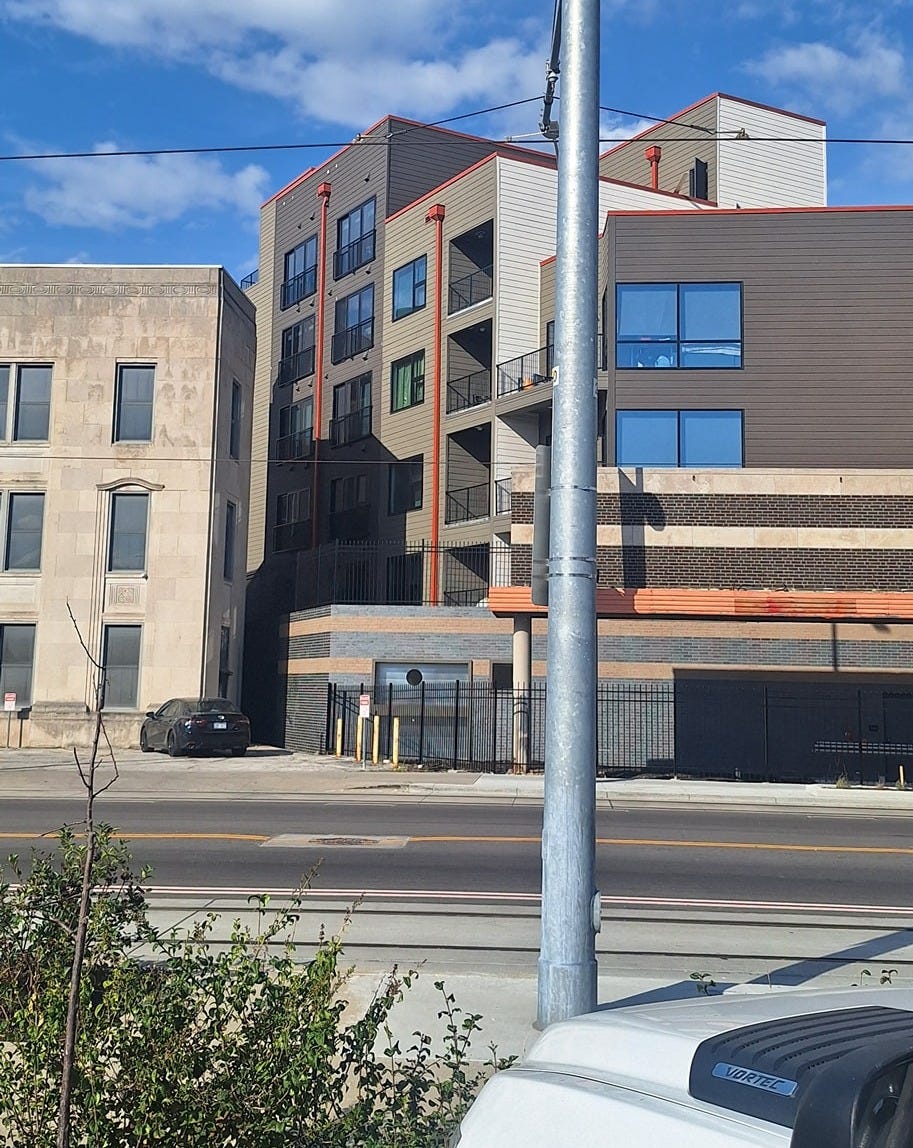
Developers throw up units along the route hoping to attract the skinny jeans crowd
I thought COVID would bring streetcar boosters to their senses. I was wrong. Having gotten away with a Potemkin plebiscite in 2017, planners were not about to look back. Jim Crow registrars put voters through fewer hoops than did this “election.” I exaggerate not. Would-be voters had to go online to get get a ballot, print it out, fill it out, make a copy of their Voter ID card, and then bring or mail the package to the Courthouse. The Sierra Club approved as did the city’s young Democrats. They had the wherewithal to overcome democracy.
In 2024, in the spirit of the 15-minute city, planners moved to bring the baseball stadium downtown. This time the measure went to an actual vote of the people. Despite millions spent to sell the idea it went down to a 58-42 thumping. Planners now are scheming to get around the people once more.
Voters seem to be aware of a factor city planners are proud to ignore. Crime. In the first half of 2025, Kansas City had 87 homicides—or 17 for every 100,000 people. In that same period, New York City had 146 homicides—1.7 for every 100,000 people. I doubt streetcar boosters will warn riders that they are TEN TIMES more likely to be murdered here than in New York City.
In my hour-long photo expedition this morning, I had encounters with three separate zombies along the street car route, happily none violent, and I was only out of my car for ten minutes. During the hour I was driving about, shooting photos of the many bike lanes now deforming our once comely boulevards, I saw exactly zero bicyclists at 10 a.m. on a 74-degree day in October.
According to Wikipedia, “In early 2023, far-right conspiracy theories began to flourish that described 15-minute cities as instruments of government repression, claiming that they were a pretext to introduce restrictions on travel by car.” Sometimes, conspiracies are more than a theory. Just ask the conspirators.

Coming soon to a neighborhood near you.
We right-conspiracy theorists push the idea of 15-minute cities as oppression because that’s what they are.
Don't complain. They burned Lahaina, HI, to get their 15-minute city and took the lives of hundreds of children. They first lied and said that three children died. Except 650 kids were out of King Kamehahah III Elementary School that day and at home because their was no electricity. With a 100 mph winds, the fire swept through the area adjacent to the elementary school and within minutes burned 2,000 houses and five hundred businesses to the ground.