

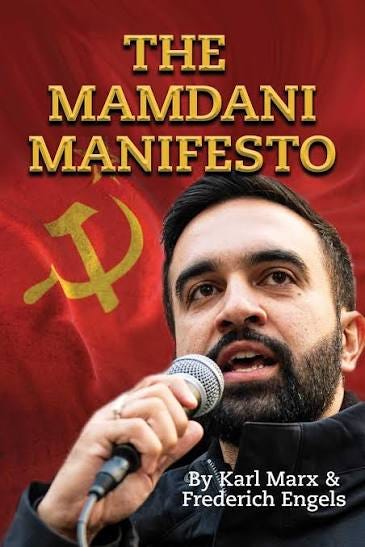
Mayor Zohran Mamdani reminded New Yorkers of Marxism’s age-old modus operandi this week when he publicly grieved for career criminal Clarence Woodward, a prisoner awaiting trial on New York’s Rikers Island.
“I am deeply saddened by the death of a New Yorker in City custody at a jail on Rikers Island early this morning. My thoughts are with his family and loved ones as they grieve this loss,” he posted on X. As to the reason why poor Mr. Woodward was in prison? Not a word. That is the way the grievance narrative works—evoke pity to advance a narrative and bury the facts that would challenge it.
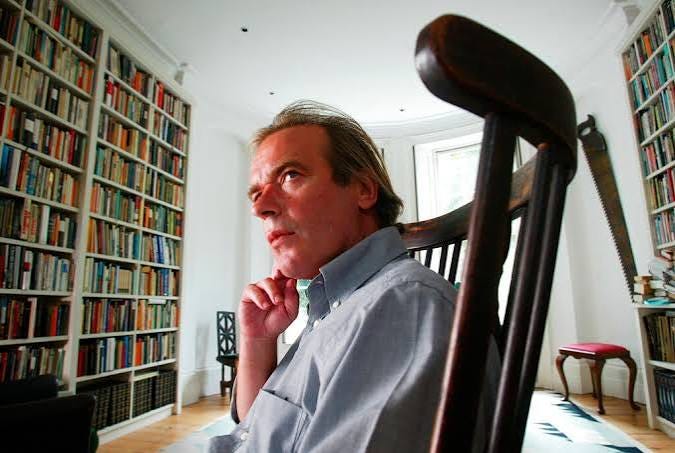
Martin Amis
British literary Martin Amis called an oversight like this a “lacuna,” meaning a gap or a hole. For Amis, the “chief lacuna” of this past 100 or so years has been that great rat hole into which the cultural establishment has shoved the memory of the most sustained experiment ever in human misery.
That experiment, wrote Amis, has been described by a variety of adjectives—”Marxist,” “Marxist-Leninist,” “Communist,” “soviet,” or even the euphemistic “socialist.” Whatever the name, at the end of the day, the contribution of this experiment to world culture was almost inevitably measured in body count.
Until his death in 2023, Amis was one of the leading literary lights of that establishment. Early in the 21st century, he took it upon himself to unearth the sins of the century past. Specifically, he wanted to know how it was that his father, equally renowned author Kingsley Amis, came to join the Communist Party in 1941 and remain a member for the next 15 years.
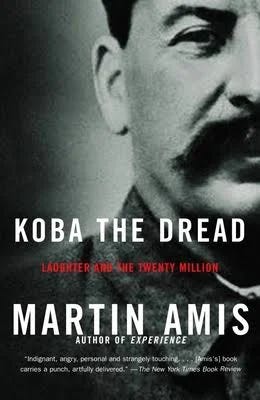
What intrigued Amis about his father’s story was its very banality. His father did what everyone seemed to be doing. “The world was offered a choice between two realities,” he wrote in his book Koba the Dread, “and the young Kingsley, in common with the overwhelming majority of intellectuals everywhere, chose the wrong reality.”
Nearly a century later, despite all the evidence, young people, intellectual and otherwise, are still choosing the wrong reality. If proof were needed, they have elected Mamdani mayor and awarded primary wins to several congressional candidates as well to senatorial candidates in Florida and Michigan.
Unlike most of his contemporaries, Kingsley Amis publicly atoned for his participation in this transparent madness. He wrote in a 1967 essay, “We are dealing with a conflict of feeling and intelligence, a form of willful self-deception whereby a part of the mind knows full well that its overall belief is false or wicked, but the emotional need to believe is so strong that knowledge remains, as it were, encysted, isolated, powerless to influence word or deed.”
There was much in the way of “knowledge” that an intellectual like the senior Amis should have known. Even before he joined the Communist Party, the Soviets had shown their true colors in the Ukrainian terror-famine, the “Great Terror,” the Moscow Show Trials, the Nazi-Soviet Pact of 1939, the subversion of the Spanish Republic, and the invasion of Finland. As with many of today’s aspiring young commies, “the emotional need to believe” trumped Kingsley Amis’s need to know.
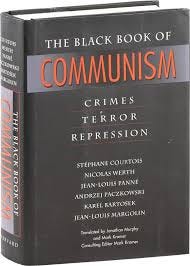
At century’s end, a group of French intellectuals, all of them former Communists or sympathizers, assembled this almost forgotten knowledge and more into the epic and authoritative Black Book of Communism. They translated the language of international communism into cold statistics: 25 million dead in the Soviet Union, 65 million in China, 1.7 million in Cambodia, and on and on.
“The dictatorship of the proletariat was a lie,” wrote Martin Amis. “Union was a lie, and Soviet was a lie, and Socialist was a lie, and Republic was a lie. Comrade was a lie. The Revolution was a lie.”
And yet, from the very beginning until the present, the Marxists and their heirs have done a masterful job of sustaining the lie, of perpetuating the fraud, of keeping virtually all memory of this undeniable evil out of the public consciousness.
Today’s crop of Marxists continue to play the classic commie shell game: conceal the Marxist evil and expose a Western one, even if imaginary. “Marxism’s greatest success,” wrote British historian Robert Conquest, “has been the demonizing of capitalism.” This success did not happen by accident. It was all part of a strategic plan, one that could never have succeeded without the enthusiastic participation of the west’s cultural establishment and its media front men.
The fraud began with Karl Marx himself. As British historian Paul Johnson shrewdly observed of Marx, “He was not interested in finding the truth but in proclaiming it.” Mamdani, his American heir, has learned from the master. “I don't think that we should have billionaires,” he recently proclaimed, “because, frankly, it is so much money in a moment of such inequality, and ultimately, what we need more of is equality across our city and across our state and across our country.”
Like other Marxists, Mamdani employs the grievance narrative to sell his self-proclaimed truths to an unthinking public. In his post about Woodward, he admits, “We do not yet know the cause of death,” but concludes by “insisting on closing Rikers Island as quickly as possible.” Rikers Island hosts more than 6500 prisoners, most awaiting trial.
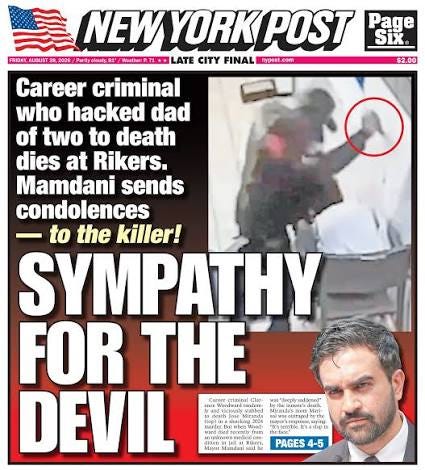
Many of Mamdani’s comrades have spoken openly about prison abolition, seeing prisons as a tool of capitalist class control. The implementation of cashless bail has been a feature of the abolition movement. With 30 prior arrests, Woodward had been a beneficiary of New York’s liberal bail policies.
Not a beneficiary was 45-year-old barber and father of two, Jose Miranda. In August 2024 Woodward walked into a Bronx laundromat and viciously stabbed the unsuspecting Miranda to death. As Josef Stalin reportedly said, “One death is a tragedy, a million is a statistic." Mamdani did not mention Miranda in his post on X. The details of that tragedy would not have advanced his narrative.
Excellent piece that discusses one of my personal pet peeves: ignoring the actual history of communism, and especially the testimony of ex-communists.
At some point, The most intellectual person in the world, me, believed, for a moment, that bail was oppressive to those who are impoverished. Thank you God. It was just a moment.